
Powerful data privacy and enhanced productivity for a leading KPO service provider
One of India’s largest BPO/KPO organizations needed to ensure the security of the highly sensitive healthcare data under their management.
Make user lifecycle management effortless - across promotions, transfers, or special projects - with one-click assignment and modification of roles, and provisioning or re-provisioning of access.
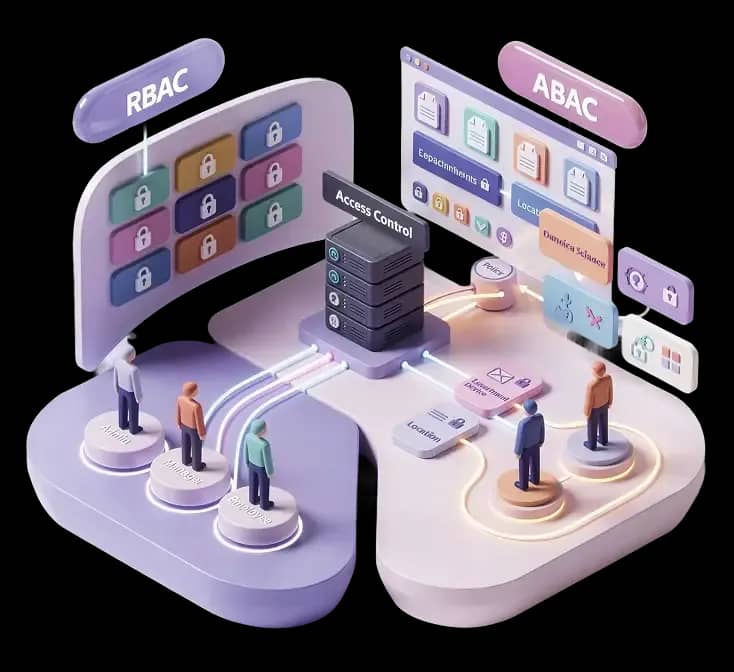
Role-based access control (RBAC) assigns permissions based on a user’s role, so users in the same role receive the same level of access permissions, with updates implemented automatically when roles change.
Attribute-based access control (ABAC) uses attributes such as department, location, or employment type in policies to determine access permissions, enabling more fine‑grained control than by using roles alone.
Centrally define and manage user roles and groups so RBAC and ABAC-based access provisioning can be propagated consistently across all connected applications and systems. This unified approach eliminates access silos and improves governance. In addition, it ensures that policy-driven access decisions are enforced uniformly across systems, regardless of where applications are hosted or how users interact with them.
Configure Segregation of Duties (SoD) rules to define specific permissions or actions, and also the conditions under which they are to be allowed or restricted. By automatically ensuring that conflicting privileges are not assigned to the same user, you reduce the risk of fraud, policy violations, and compliance failures. Enforcing clear boundaries between incompatible responsibilities is especially important in the case of sensitive processes.
Detect conflicting actions or permission policy violations automatically through continuous monitoring of user roles and access permissions against defined segregation of duties (SoD) rules. As issues are identified early, timely corrective action is possible. This proactive approach addresses risks before they occur, strengthens governance, supports regulatory compliance, reduces problematic audit findings, and ensures policy violations do not remain unnoticed across critical business systems
Automatically remove or modify conflicting permissions or violations of SoD (segregation of duties) rules in user roles and authorizations, whenever such violations are detected. Such automated remediation minimizes reliance on manual clean-up after the fact, and closes security gaps quickly. By enforcing corrective actions in near real time, organizations reduce exposure to risk and ensure access policies remain compliant without adding operational overhead.
Enforce multi-level approval workflows for high-risk access requests to ensure elevated permissions are granted only after thorough review and approval by designated authorities. This approach ensures accountability, prevents unauthorized privilege escalation, and reduces the risk of misuse. By adding a critical governance layer for sensitive access, organizations maintain transparency, improve compliance, and ensure access decision processes are consistently documented and auditable.